Rethink work and team. Capture the full speed and scale of AI.
Drop even the best AI into vague and fragile work and it gets lost – just as a person would. But a person can stop and ask for help. An agent that stops to ask has lost the speed it was hired for. To solve this, Finnite created Provua, the Unified Execution platform that structures and governs the work – clearly defining the work, the team and the authority to decide.

One platform to define the work and the team – for your human and silicon workforce.
Most companies start with the agent and attempt to engineer it to navigate the mess. We start with the work. Provua establishes the structure and governance of every project and process, so your teams can mint AI agents on demand.
Agents can’t run at full speed with a person in the loop. Provua puts people on the loop. Risk-based authority sets what agents decide, and how – so you stay confident they’ll hit their targets, follow procedure, manage their risks and measure honestly.
Rented, bolted onto a single app, or engineered as a pipeline. Each one automates the work as it is – vague and fragile, now at agent speed.
A clear outcome, owner, authority, risk boundary and workflow. Every agent and every person knows exactly what they’re landing in.
Agents don’t fix vague and fragile work. They accelerate it.
Every project and process sits in an accountability tree that sets leadership and delegation roles. A shared view of risk sets who decides, who is consulted and when to escalate.
Specialist agents guide workflow, curate knowhow, capture signal and manage risk. People approve the work and team, and agents run to the delivery criteria.
With the structure and governance in place, a new agent needs only a role description and a set of skills. Teams initiate it, Provua mints it, and your company keeps it.
Provua decomposed the project – a six-layer circuit board for a children’s wifi gateway – and minted a swarm of agents to deliver it. It finished 20x faster, with under 10% of the human effort, at 7x lower cost* – with a human review board gating every phase.
*Against a conventional engineering team estimate; costs at corporate API pricing.
It taught me hard lessons about structuring larger teams to deliver complex strategies. Traditional organisational restructures take too long, create team anxiety and are obsolete almost immediately.
When your structure fails to adapt to your strategy, work becomes vague, and execution becomes fragile. I know exactly what this pain feels like. Whether you are leading 50 or 5000, this structural entropy always presents as eight distinct symptoms.
$2B NASDAQ · Founder · OperatorReview the symptoms below. If your organisation exhibits any of these at a significant scale, you are not suffering from a talent problem—you are suffering from a structural failure.
Outcome disconnected from the strategy
Outcome impeded by lack of authority
Outcome wasted through uncoordinated overlap
Outcome believed impossible by team
Outcome compromised by invisible capacity conflicts
Outcome perceived as unimportant by team
Outcome reliant on unsustainable effort
Outcome not valued by stakeholders
In the past, cheap capital and stable markets masked structural bloat. Growth at all costs was rewarded. Not anymore. Between unpredictable inflation, sudden supply chain shocks, and the relentless pressure to drive organic growth in saturated markets, the macroeconomic environment is unforgiving.
AI is being touted as the saviour, but dropping advanced technology into a fragile organisational structure doesn't create agility — it just accelerates the confusion. If your teams already suffer from Disconnected or Defeatist work, AI will not save them. In fact, you must explicitly structure your teams around the new capabilities AI brings to your organisation.
To outmanoeuvre your competitors in a high-velocity environment, you must be able to rapidly translate strategy into well-structured, robust execution.
In a Finnite-designed structure, delivery teams are dynamically allocated into the work. A shared risk framework aligns the team's mental model of the work and its interconnections to the wider organisation. This methodology is purpose-built for organisations with 100+ knowledge workers, or those navigating hyper-growth.
Once your direct team learns how to build work containers that unify execution, the methodology will naturally propagate down through your teams.
Our 5-step Unified Execution Road Map begins with demonstrating immediate productivity gains, achieved by changing how the C-Suite structures the delivery of your strategy.
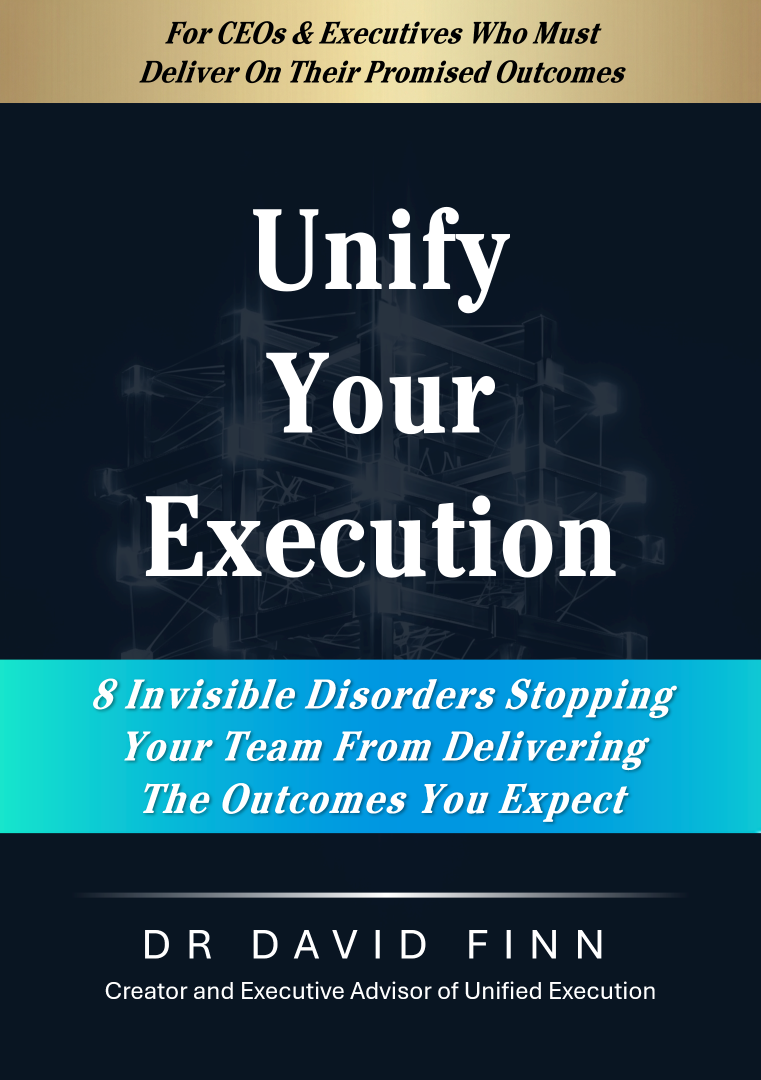
Order your complimentary copy of The Unified Execution System and schedule a discovery session. One conversation is all we need to understand if Unified Execution is right for your organisation.
Order Your Book & Discovery Session →